Huang Cha (黄茶) is the rarest type of tea in China, representing less than 1% of national production. Often confused with green tea due to the initial color of its leaves, it is distinguished by a very specific processing step: the Men Huang
This micro-fermentation technique breaks down the natural bitterness of green tea and develops aromas of roasted cereals, chestnut and sweetcorn.
The chemistry of Men Huang
Making yellow tea requires extreme precision. Poor temperature or humidity control will transform the batch into ordinary green tea or an unusable oxidized batch.
The process is structured around three major stages:
-
Fixing (Sha Qing) The leaves are briefly toasted in a wok to stop the action of oxidation enzymes, as with green tea.
-
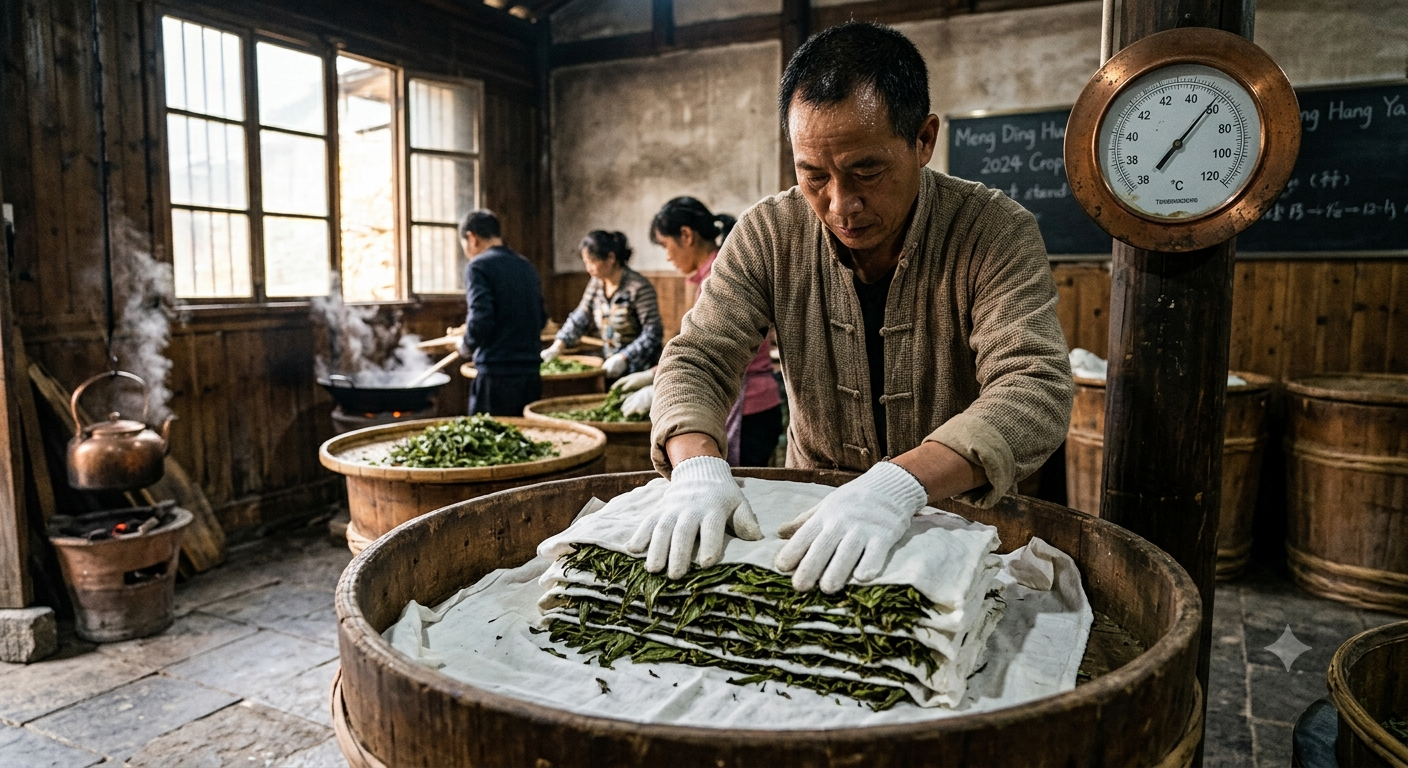
The suffocation (Men Huang) While still warm and moist, the leaves are wrapped in tissue paper, fabric, or stacked in wooden crates. Under the influence of residual heat and steam, a slow, non-enzymatic oxidation occurs. The catechins break down, the chlorophyll fades, and the flavones take over, giving the liqueur its yellow hue.
-
Drying A final pass through the flames stops the reaction and fixes the aromatic profile.
This transformation lasts between 24 and 72 hours depending on the weather conditions and the help of the producer.
Taste profile and digestive tolerance
The work of Men Huang alters the structure of polyphenols, which changes the impact of tea on the body.
-
Less astringency : The lower level of crude catechins makes the tea much gentler on sensitive stomachs.
-
Aromatic notes The liqueur is golden and velvety. It has aromas of dry straw, warm bread, sunflower seeds and sweet butter.
-
Stimulating effect The combination of theine and L-theanine provides a steady supply of energy without the sudden jittery effect.
The three benchmark wines
Depending on the fineness of the plucking, yellow tea is classified into three distinct categories:
| Name of tea | Origin (Province) | Type of picking | Cup profile |
| Jun Shan Yin Zhen | Hunan | Exclusive buds | The rarest. Creamy liqueur, with notes of sweetcorn and butter. |
| Meng Ding Huang Ya | Sichuan | Buds and young shoots | Notes of hazelnut, toasted rice and mild vegetal character. |
| Huo Shan Huang Ya | Anhui | Bud + 1 to 2 leaves | More structured. Notes of dry grass and chestnut. |
Brewing parameters
To preserve the material without extracting any false notes:
-
Water : Opt for spring water that is low in minerals.
-
Temperature : 80 °C to 85 °C.
-
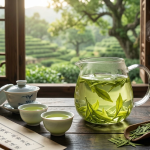
Container : A Gaiwan in porcelain or a tall transparent glass to observe the vertical descent of the buds.
-
Time : 3 minutes in a classic teapot, or successive bursts of 30 to 45 seconds using the traditional method (Gongfu Cha).